Armenia packs a country's worth of stone, altitude and silence into a space you can cross in a day — which is exactly the problem. The monasteries sit on ridge lines and at the bottom of river gorges, the villages between them are small, and the roads, though mostly paved, have a habit of coiling. This ten-day loop runs from Yerevan through Vayots Dzor, Syunik, Lake Sevan, Dilijan, Lori and Shirak before closing back on the capital. Most days involve a transfer, but rarely more than four hours at the wheel, and there is room left for the thing you will want most: an hour alone on a monastery terrace with the wind and nobody else around.
Distances below are rough driving times in good conditions. Add a third again for photo stops, livestock on the road and the fact that mountain driving is slower than the map suggests.
Land, drop your bags, and don't attempt anything ambitious. The smart first move is west to Vagharshapat (Etchmiadzin), thirty-five minutes from the centre, where the cathedral — often described as the oldest in the world — sits beside the churches of St Hripsime and St Gayane. Check locally on restoration work before you go; parts of the complex have been under long repairs. Stop at the Zvartnots ruins on the way back for the light at the end of the day.
Day two is the long push south, and it works best started early. Garni is forty minutes from Yerevan, its Hellenistic colonnade perched above the Azat gorge; Geghard is ten minutes further up a road that narrows between cliffs, the monastery half-built and half-carved into the rock. From Geghard, cut back through Yerevan's ring road to Khor Virap — an hour and a quarter — where the Ararat plain opens up and the mountain shows itself if the haze allows. Late afternoon is usually clearer than midday.
From Khor Virap it's about an hour and forty minutes to Yeghegnadzor. Sleep there, or better, in one of the villages just outside it.
Noravank is thirty minutes from Yeghegnadzor, up a red-rock gorge that dead-ends at the monastery gate. Go at opening time. The two-storey Surb Astvatsatsin church, reached by a stone stair cantilevered out of the facade, is the image most people carry home from Armenia, and by ten in the morning it is busy.
Continue south through Areni — the wine country, and worth a stop for a tasting and a look at the cave area — then commit to the drive to Tatev, roughly two hours and fifteen minutes with a break. The Wings of Tatev cable car saves you a steep, winding descent and climb, and the ride over the Vorotan gorge is one of the longest passenger cable rides anywhere. Check operating days in advance; wind closes it.
The monastery itself is the reward: a ninth-century complex on a plateau above the gorge, with a swinging pillar that monks once used to detect earthquakes. Sleep in Tatev village or push on to Goris, an hour and fifteen minutes further.
Day four is deliberately gentle. Drive twenty minutes from Goris to Khndzoresk, where cave dwellings hollow out a long ridge and a suspension bridge sways across the valley. Then spend the afternoon in Goris itself, whose old quarter of black basalt houses and worn cobbles is one of the most atmospheric towns in the country. Two nights in the same bed will feel like a luxury.
This is the big transfer day, so set off early. From Goris, the road climbs through Vardenyats Pass to the Selim caravanserai, a fourteenth-century stone resting place at around 2,400 metres — about an hour's drive, with an optional detour to Vorotnavank on the way. The caravanserai is a dark, vaulted shell where camel trains once sheltered; on a clear morning you can see a long way back down the valley.
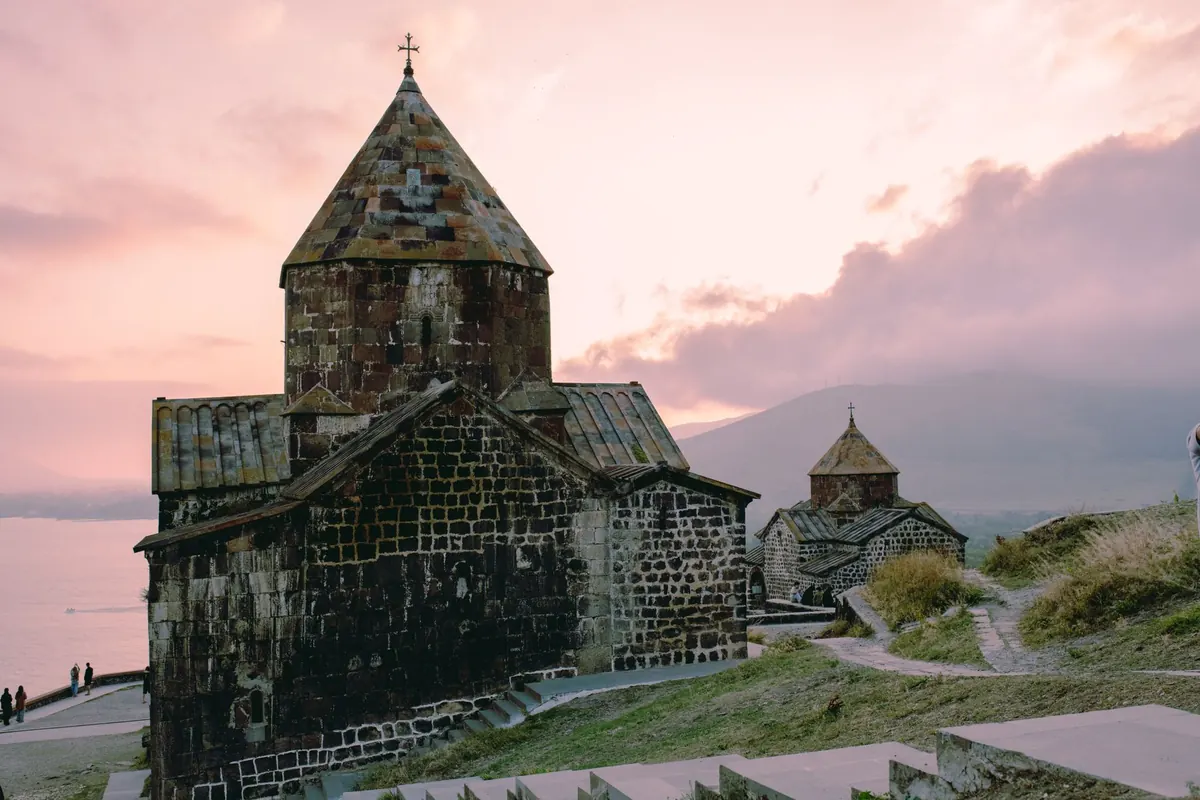
Descend to Noratus, an hour east, where a field of carved khachkars — cross-stones — spreads out beside the road in the largest such collection in Armenia. Then follow the western shore of Lake Sevan: Hayravank, then Sevanavank on its peninsula, forty minutes further. If you have any energy left, the water is cold and the wind is constant and the view from the monastery steps at sunset is worth the whole day's driving.
Sleep in Dilijan, forty-five minutes on, rather than by the lake. The forest air is a better night's rest than the exposed shore.
Dilijan is a spa town that has been rebuilt around its own reputation, but the old quarter — Sharambeyan Street and its timber balconies — still holds. More importantly, two of Armenia's loveliest monasteries sit in the woods half an hour away.
Haghartsin takes thirty to forty minutes on a winding road; the refectory, with its stone vaulting, is the highlight. Goshavank is another half hour on, quieter and set among trees. Give the afternoon back to the town, or walk one of the marked forest trails above it.
Day seven heads north to Lori, roughly two hours. Haghpat and Sanahin, both UNESCO-listed, sit within fifteen minutes of each other above the Debed canyon, and between them you can spend three unhurried hours. Sleep in Haghpat village or in Alaverdi below.
Start with Odzun, twenty minutes from Alaverdi, and its unusual seventh-century basilica; then Kobayr, fifteen minutes on, a monastery half-swallowed by a cliff. From there it's about two hours west to Gyumri, the country's second city, where the black-and-orange tuff buildings, wide streets and slow pace make an easy evening.
On day nine, loop out of Gyumri: Marmashen is twenty minutes away, on the Akhurian river; Harichavank is thirty minutes in the other direction. Both are quiet and both are worth an hour. Yereruyk, near the closed border, is a further forty-five minutes south if you want a fourth. Then take the two-hour highway back to Yerevan and stay in the city.
Keep the last day light. Forty-five minutes from Yerevan, Saghmosavank sits above the Kasakh gorge, with a library built over the void; Hovhannavank is ten minutes further and has one of the finest carved facades in the country. Continue to Talin's cathedral and Aruch's ruined basilica if your flight is late, then return to the capital with time to spare.
Some groundwork makes this route far easier:
What this route asks in return for its monasteries and passes is patience with the road — a willingness to stop when a village woman flags you down to buy apricots, to sit through a slow lunch in Goris, to accept that the drive takes what it takes. That is, in the end, the point of coming.
Photo: Oleksiy / Pexels