Jerusalem is small enough to cross on foot and complicated enough to ruin a day if you have not checked the calendar. First-time pilgrims usually arrive with a strong list of places — the Western Wall, the Holy Sepulchre, the Mount of Olives, the Upper Room — and very little sense of how the city's hours, dress codes and transport actually work. The holy sites rarely disappoint. The hour before them often does.
What follows are the ten mistakes that come up most often, along with the practical fixes that keep a pilgrimage from turning into a logistics exercise.
Jerusalem runs on three calendars at once — Jewish, Christian and Muslim — and each one closes something.
The most common error is booking a Friday afternoon arrival and expecting a normal city. From roughly mid-afternoon on Friday until Saturday evening, much of Jewish west Jerusalem shuts down: buses, the light rail, many shops and restaurants. The Old City stays busier, and the Muslim and Christian quarters keep their own rhythms, but your transport options shrink sharply. Plan Friday as a day to finish your shopping, confirm how you are getting back to your hotel, and be where you want to be by two o'clock.
Non-Muslim visitors are allowed on the Temple Mount (Haram al-Sharif) only during limited hours — usually weekday mornings and early afternoon — and entry stops during Muslim prayer times, on Fridays and Saturdays, and on Muslim holidays. Check the current schedule the day before, arrive early, and expect a queue and a security check. Visitor entry is via the walkway beside the Western Wall.
The Holy Sepulchre is shared by several communities on a delicate, historic timetable, and its hours shift with the season and with Easter — which the Western and Orthodox churches usually celebrate on different dates. Mid-morning is peak group time. Go at opening, or in the last hour or two before closing, and you will actually be able to stand still in the rotunda instead of being carried through it. If your trip overlaps Holy Week, assume the basilica will be crowded and the timetable unreliable. The same applies around Orthodox Easter, Ramadan and major Jewish holidays.
Modest dress is not a suggestion at most sites. Shoulders and knees covered, for men as well as women, is the baseline; a light scarf in your bag handles hair, shoulders and sun in one move. At the Western Wall, men and women have separate sections, men are expected to cover their heads — disposable kippot are usually available — and women should dress modestly. Keep voices low, do not photograph people mid-prayer, and step back from the wall rather than turning your back on it if you want to follow local custom. A light scarf and a respectful manner will get you further than any guidebook.
At the Temple Mount, the rules are stricter and can change. Non-Muslim visitors are not permitted to pray there, and visible religious display can cause problems at the entrance. Remove or cover what you can, follow instructions at the gate without argument, and read the current rules before you go. At churches, a scarf over the shoulders and a skirt or trousers below the knee will usually be enough.
First-time pilgrims often draw a line from the Mount of Olives to the Western Wall to the Holy Sepulchre to the Upper Room and call it a day. On paper it looks efficient. In practice, each move costs twenty to forty minutes once you add gates, security checks, queues, stairs and the simple fact that the Old City is not laid out on a grid.
Build in fewer sites and more time. A workable split is to give one day to the Christian Quarter and the Western Wall, and another to the Mount of Olives, the City of David and the southern walls. If you have only one day, choose three anchors and let the rest be a bonus.
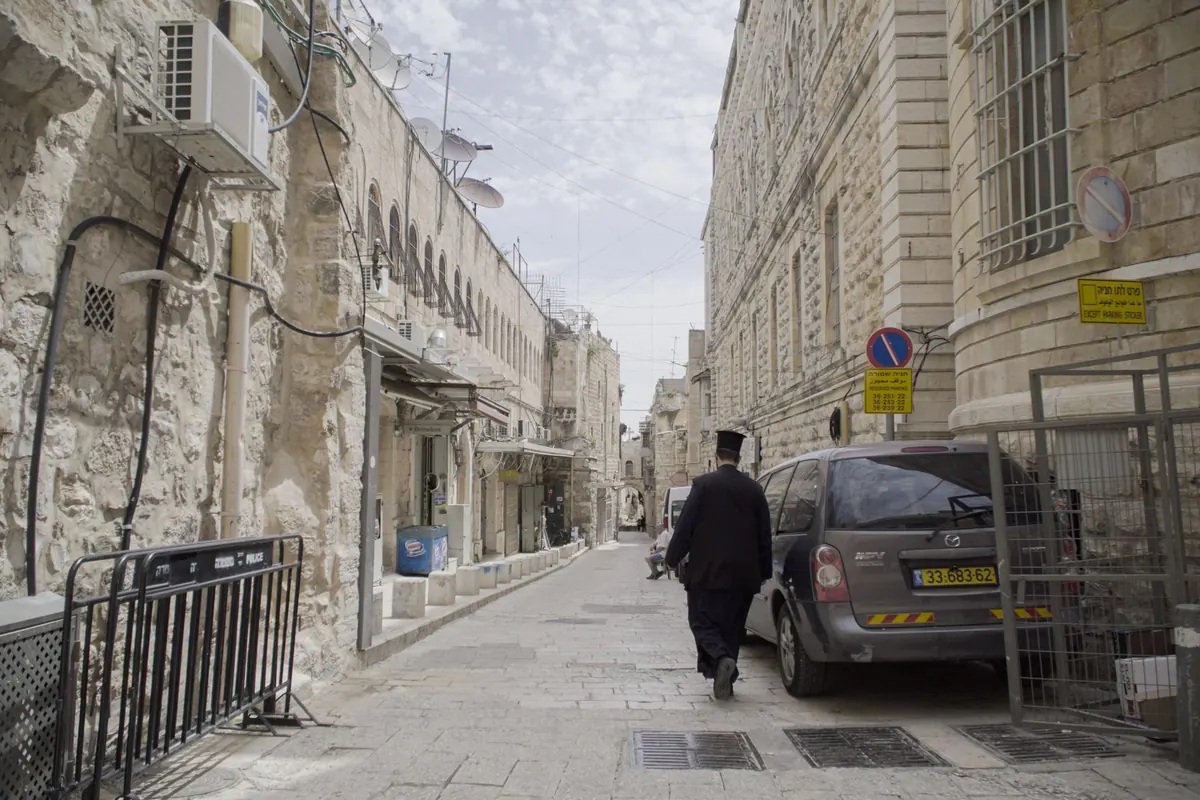
The Old City is four quarters, eight gates and a maze of alleys that change name every few turns. GPS helps until it does not; in covered passages it drifts, and in crowds it lags. Learn the gate names — Jaffa, Damascus, Lion's, Zion, Dung, Herod, New and Stephen's — and use them as your anchors. Ask for landmarks rather than street names: "near the Austrian Hospice" or "above the Via Dolorosa" is more useful than an address.
Practical rule: if you cannot name the gate you are aiming for, you are not ready to navigate the Old City on a tight schedule.
Allow a buffer between sites. The walk from Jaffa Gate to the Holy Sepulchre is not long, but it is not direct either, and the market streets can swallow half an hour without warning.
Jerusalem is modern, but it is not frictionless. Small vendors, falafel counters and taxis may prefer cash; some places close early on Friday; and a dead phone means no map, no tickets and no way to reach your hotel. Carry a modest amount of shekels in small bills, keep a card as backup, and download an offline map before you leave. A local SIM or eSIM is useful, but do not rely on it inside thick stone passages.
A power bank is not a luxury. Between photos, maps and group messages, your phone will die by mid-afternoon. Keep your passport or ID with you, too; security checks can ask for it, and a photocopy on your phone is not always enough.
Photography is allowed in many places, but not everywhere, and not at every moment. The Holy Sepulchre can be both a pilgrimage site and a crowded bottleneck; the Western Wall is an active place of prayer; the Temple Mount has its own rules and sensitivities. Do not use flash, do not block aisles, and do not photograph people who are praying without asking. If a service is underway, put the camera down.
A good photograph of a holy place should not require someone else to stop praying.
Watch for posted signs and follow them. If you are unsure, ask a guard or a member of the community. The answer may be "not here," and that is part of respecting the site.
Security checks are part of visiting Jerusalem. Bags are scanned at major sites and gates, and you may be asked to open a water bottle or show ID. Carry a bag you can open quickly, avoid packing anything you would not want inspected, and leave extra time at the Western Wall, the Temple Mount and the Holy Sepulchre. Crowds peak around Friday prayer, Ramadan, Easter and Jewish holidays; the sites are still visitable, but the pace changes.
Do not argue with security staff. If you are turned away, ask politely what the current rule is and whether there is another entrance or time. A ten-minute wait at the gate is better than losing an hour to frustration.
Jerusalem is built on hills and paved with stone that reflects heat. First-time visitors routinely walk more than they planned, skip lunch and drink too little water. The result is a headache by three o'clock and a pilgrimage that feels like a forced march. Wear shoes you have already broken in, carry water, and plan a real rest. The Mount of Olives is the classic trap: walking down is easy, walking back up in the afternoon sun is not. Take a taxi or bus back, or save the descent for the end of the day.
Bathrooms are not everywhere in the Old City. Use them at sites, restaurants and cafes when you can, and keep a little cash for public facilities.
Not every friendly person who offers to show you the sites is a licensed guide, and not every tour is a good fit for a pilgrim. Some tours are excellent; others are shopping commissions with a few stops attached. Ask about the language, the duration, the entry fees and whether the route includes time for prayer. Book through your hotel or a reputable operator if you want structure, or agree on the price and the itinerary before you set off.
You are allowed to say no. A pilgrimage is not improved by being pulled into a spice shop because someone else set the schedule.
The last mistake is the quietest: treating the trip as a checklist. Pilgrims come to Jerusalem to pray, and then fill the day so tightly that there is no room left for it. Leave one afternoon unscheduled. Sit in a courtyard. Return to a site at a different hour. Let the city slow you down. The memories that last are rarely the ones you rushed to collect.
If you have two days, use them like this:
This is not a rule, only a shape. The point is to group sites by quarter and by hill so that you spend less time crossing the city and more time standing still.
Jerusalem rewards attention more than speed. The first-time pilgrim who avoids these mistakes will still get lost once, still wait in a queue, and still find the city larger than the map. But they will also find the hour before the holy site less hurried, and the holy site itself more open.
Photo: Jakob Lundvall / Pexels